
I've been the only marketer on the team more than once. When that happens, nobody hands you a job description that stops at SEO. You run the ads, fix the product pages, send the emails, and pull the report on Monday.
That's what a full stack marketer is.
What Is A Full Stack Marketer
A full stack marketer is one person who can handle the whole marketing function: strategy, execution, and results. Not just one channel.
The term comes from web development. A full stack developer works on both the front end and the back end of a site. A full stack marketer does the same thing for marketing: the creative side and the technical and data side.
It doesn't mean being an expert at everything. It means knowing enough about every piece to see how they connect, being strong in a few, and knowing when to bring in help.
What The Stack Usually Includes
Every business needs a different mix, but most full stack marketers work across:
- SEO and content: keyword research, on-page fixes, technical audits, and content planning
- Paid ads: Google Search and Shopping, budgets, and reporting tied to actual sales
- Email: campaigns, automated sequences, and list management
- Website for business services, eCommerce, or both: service pages, product pages, product data, catalog management, and conversion fixes
- Analytics: reading the numbers and knowing what to do next
- Copywriting: product descriptions, landing pages, and ads
The real value isn't any one of these. It's that they're run as one system. When the same person handles SEO and paid search, the two stop working against each other.
Full Stack Marketer Vs. A Marketing Specialist
A marketing specialist goes deep on one and maybe a little into another. A full stack marketer goes wide, with a few deep spots.
Picture a T. The top bar is everything you know enough to work in. The vertical line is where you go deep. Mine is SEO and eCommerce.
Larger companies need specialists because they have enough work to keep each specialist busy. Small and mid-size businesses usually don't. They need one person who can cover the whole thing and know when it's time to hire a specialist.
About Those Unicorn Job Posts
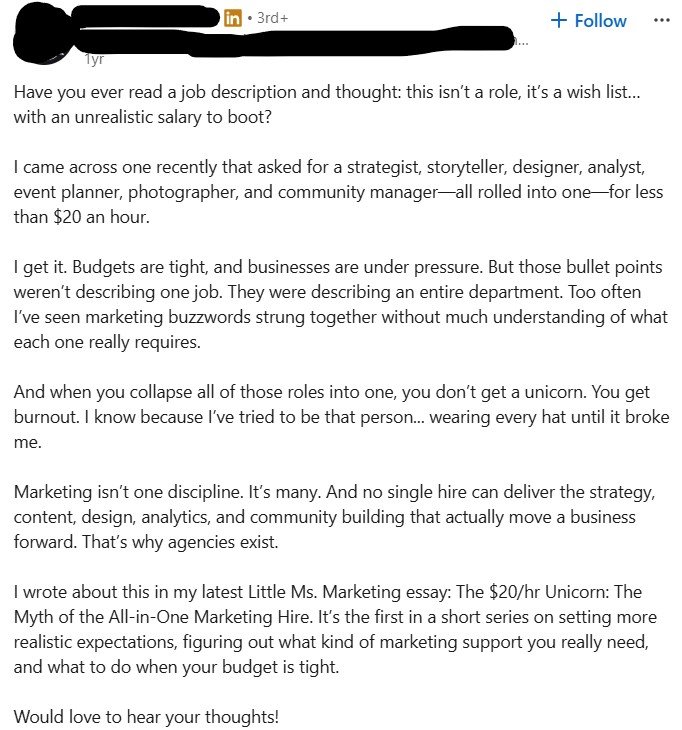
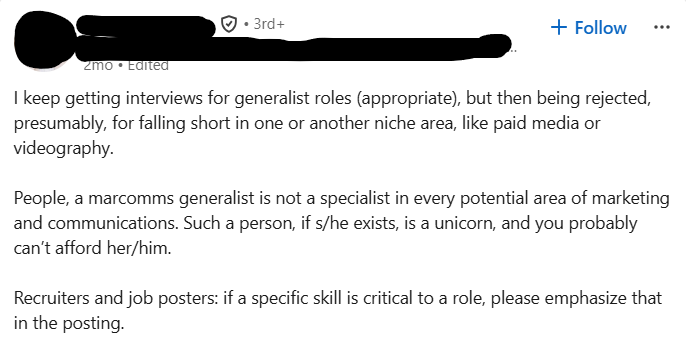
You've probably seen them. One marketing job that asks for SEO, paid ads, social, email, graphic design, video, web development, analytics, and event planning. Sometimes at an entry-level salary.
A lot of people online say these jobs are unrealistic. Nobody can do all of that.
I read them differently. Most of the time, that list isn't what the business expects on day one. It's the want list.
The business owner or hiring manager is writing down everything marketing touches at their company. They know they can't afford a person for each piece. So they're looking for someone who can handle the most important pieces now and grow into the rest.
That's the job of a full stack marketer. Nobody walks in doing all of it. You start where the business needs it most and build from there.
If you're job hunting: don't skip a posting because you can't check every box. If you've got the core skills and you're willing to learn the rest, apply. In the interview, ask which pieces matter most in the first 90 days. That tells you what the job really is.
If you're the one writing the post: split it into "needs now" and "nice to have." You'll get better applicants, and fewer good ones will talk themselves out of applying.
What Is A Full Stack Digital Marketer
Same idea, focused on online channels. Most people use the two terms the same way now, since most marketing for a small business happens online.
What About A Full Stack Marketing Manager
That's usually a full stack marketer with a bigger say in strategy and budget, and sometimes freelancers or a small team to manage. They still do hands-on work. They also decide where the money and time go.
How To Become A Full Stack Marketer
Nobody hands you a certificate for this. You get there by doing the work.
- Start with one strength. Get good at one area first. SEO, ads, or content are all solid places to start.
- Take the jobs nobody else wants. Fix the product feed. Set up the analytics. Build the landing page. That's how the stack grows.
- Learn how the pieces connect. Watch how a change in one channel shows up in another. This is the part specialists don't always get to see.
- Get comfortable with the data. You don't need to be an analyst. You need to read a report and know what to do with it.
- Work at a small company. When you're the only marketer, you learn the whole stack fast because you have to.
If this doesn't sound like you, don't do it. It's challenging, but rewarding at the same time.
How I Got Here
I didn't plan it. It started when I was in college and started working at a custom competitive swimwear company and picked up product listings and SEO. From there I ended up spending a few years running eCommerce and marketing for an industrial distributor in the hose business. That meant rebuilding the site, running the ads, managing product data, and handling customer orders. One person, the whole function.
The site went from almost no organic visibility to 8,000+ ranking keywords and nearly $500K in online sales in my final year.
As of October 2026, I'm working in building materials eCommerce for a company with 14 locations across Georgia, Tennessee, Florida, and South Carolina.
If you're a business that needs someone like that, here's what full stack marketing looks like when you hire me.
☕