

Recently I was in an online discussion about product titles in eCommerce. Someone made the claim that putting a SKU in the product title messes up your schema and just looks ugly. I disagree: at least not across the board.
The schema argument is a partial truth at best. And “looks ugly” depends entirely on who’s looking at it. A purchasing agent searching a part number doesn’t care how it looks in the title. They care that it showed up.
This isn’t a one-size-fits-all answer. It never is in eCommerce. The right call depends on who your buyer is, how they search, and what industry you’re in. That’s what this post breaks down.
SKUs in the Product Title
B2B buyers don’t browse. They already know what they need before they search. They have a part number, a spec sheet, or a reorder list. The title’s job isn’t to sell them: it’s to show up when they search.
- They’re sourcing, not shopping: A purchasing agent searching a SKU has already made the decision. They need to find the product and get a quote. If your title has the part number and a competitor’s doesn’t, you show up and they don’t. That’s it.
- Real traffic from real part number searches: Running eCommerce for an industrial hose and hydraulics distributor, exact part number searches drove a measurable chunk of organic traffic. Not accidental visits. Buyers who knew exactly what they needed.
- Multiple distributors carry the same product: In industrial and technical markets, you’re rarely the only source. The SKU is the differentiator. It’s how a buyer finds you instead of someone else.
- Reorders are real: B2B customers come back. When someone searches the part number they ordered six months ago, your title either shows up or it doesn’t. General keyword optimization doesn’t solve that.
- It helps in Google Shopping too: Having the SKU in the title improves product matching in Merchant Center. Paid and organic both benefit from the same high-intent search.
- Put it at the end: The SKU doesn’t need to lead the title. Front-loading a part number that means nothing to a casual browser hurts CTR. At the end it catches part-number searches without pushing your primary keywords out of the visible window.
- These buyers convert: Someone searching a SKU isn’t comparing options. They’re checking availability and price. The decision is already made.
SKUs Not in the Product Title
This argument isn’t wrong. It’s just built for a different kind of store.
- General shoppers don’t search by SKU: Someone looking for wireless earbuds or a new jacket isn’t typing a part number. A SKU in that title takes up space that could go toward something they actually searched.
- Character space matters, especially on mobile: Titles truncate around 50 to 65 characters. On mobile it happens faster. If a SKU is pushing a real product descriptor out of the visible window, that’s a click you’re losing.
- Consumer brands don’t build recognition through codes: If someone finds you through a keyword search and sees a string of numbers and letters in the title, that’s not helping them connect with what you’re selling.
- The trade-off is real: A SKU runs anywhere from 6 to 15 characters. In a consumer catalog those characters could be a color, a size, a material: something a shopper actually typed.
- The advice is valid, just not universal: It comes from people working in consumer eCommerce. It’s right for that world. The problem is when it gets handed down as a blanket rule for every industry.
Addressing the Schema Argument
SKU belongs in your structured data. That’s not up for debate. But that’s a separate conversation from your title tag. Both can include the SKU and both should, if your buyer is searching for it. The person in that discussion conflated two different things: where Google reads product identifiers for indexing purposes, and what shows up in a search result title. One doesn’t cancel out the other.
If you’re using WooCommerce or a similar platform, your SKU should absolutely be in your product schema. That helps Google understand and match your product. But nothing in schema guidance says it can’t also live in the title. They serve different purposes and can work together.
The Real Question: Who is the Customer?
This is where the debate usually falls apart. Most of the “no SKU in the title” advice comes from practitioners working in consumer eCommerce. That world has different rules. A shopper browsing for shoes or skincare isn’t searching by part number. That advice is correct for that context.
But apply it to a B2B catalog selling industrial parts, hydraulic fittings, or hardware components and it breaks down completely. The buyer is different. The search behavior is different. The intent is different.
In B2C, the title needs to speak to someone discovering your product for the first time. In B2B, the title often needs to speak to someone who already knows exactly what they want and just needs to find where to get it. Those are two completely different jobs.
The Verdict
The debate over SKUs in product titles isn’t really about SEO rules. It’s about knowing your buyer.
If your customer is a general consumer discovering a product for the first time, SKUs in the title are wasted space. Use every character for something they actually searched.
If your customer is a B2B buyer, a purchasing agent, or anyone sourcing a specific part in a technical industry, the SKU might be the most important thing in your title. It’s not clutter: it’s the exact search term that gets you found.
The mistake isn’t following one camp or the other. The mistake is applying consumer eCommerce logic to a B2B catalog, or vice versa. Know who is buying from you, how they search, and what they need to see to click. That’s what drives the decision, not a universal rule someone handed down in a forum. Keyword research is where this decision lives—and if you haven’t mapped out how your actual customers are searching, the eCommerce SEO breakdown is a good place to start.”
Schema handles what it handles. Your title tag handles what it handles. Both can include the SKU and both should, if your buyer is searching for it.
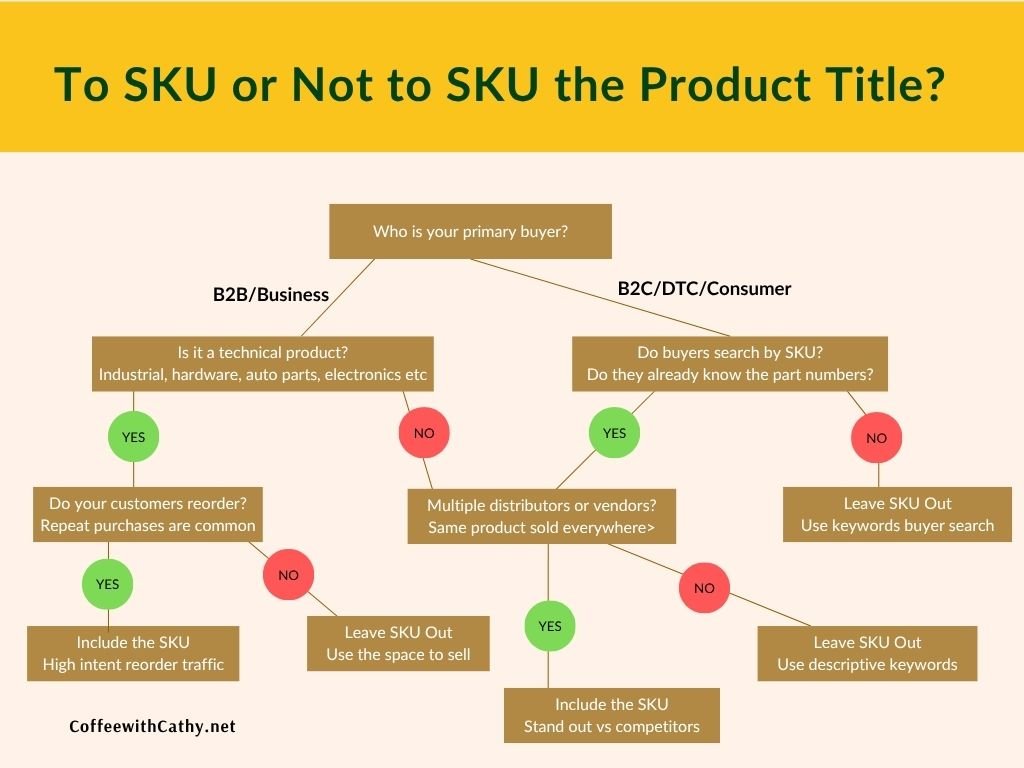
So Should It Be Included?
Follow the questions and answers to help you decide, you don’t have to know the ins and outs of the technical areas, just simple logic.
If you’re building or auditing a product catalog and want a second set of eyes, this is the eCommerce work I do.”
Schema is only part of it—if your store is running on outdated theme architecture, even correct data can get stripped or ignored. This piece on deprecated Shopify themes covers exactly what that looks like.