
eCommerce SEO That Drives Sales, Not Just Rankings
Most SEO advice was written for blogs, information sites, and service businesses. eCommerce is different: thousands of product pages, category structures, Google Shopping feeds, and algorithm updates that treat your store differently than a content site.
Why eCommerce SEO Is Different
A blog post ranks by being the best answer to a question. A product page ranks by being the most relevant, trustworthy result for a purchase search, across hundreds or thousands of similar pages, without looking like duplicate content.
The problems are different too:
- Faceted navigation creating thousands of thin indexed pages
- Out-of-stock products losing rankings
- Product titles written for the internal catalog, not how customers search
- Category pages with no content
- Best sellers buried four clicks deep
These aren't beginner problems. They're structural, and fixing them takes platform knowledge.
How I Wor
Every project starts with a technical audit. Most stores have problems nobody has caught: pages indexed that shouldn't be, titles that don't match how customers search, feed data that contradicts the product pages it pulls from.
Next is keyword research focused on purchase intent. Not the highest-volume terms: the ones the right customer searches when they're ready to buy or compare.
Then on-page optimization, category structure, and feed quality, in order of impact. Organic and Shopping often pull from the same product data, so cleaning the feed tends to improve both.
Progress is tracked in Search Console and Semrush. Reports cover what changed and why, so you can see the work turning into sales.
eCommerce SEO Includes
Grab a coffee and scroll through.
Product Page Optimization
Titles, meta descriptions, H1s, body copy, and schema markup structured the way search engines read them. For B2B, that means SKUs, part numbers, specs, and the technical terms customers actually search.
Category And Navigation Structure
Category structure decides what you can rank for. I audit hierarchies, faceted navigation, and internal links so search engines can find your best pages and customers can reach products in as few clicks as possible.
Technical SEO
Crawlability, indexation, site speed, variant duplicates, pagination, canonicals, and XML sitemaps. On a large catalog these compound fast. I audit at scale with Screaming Frog, Semrush, Ahrefs, and Sitebulb.
Google Shopping And Feed Optimization
Merchant Center is where a lot of eCommerce SEO shows up in revenue. Titles, descriptions, and attributes in the feed decide where products show up in Shopping. I've managed feeds for B2B businesses and know what gets products approved, flagged, and ranked.
Keyword Research For Niche Products
Finding how customers describe your products, not how your catalog does. For industrial and technical businesses, that means bridging part names and plain-language searches. Example: metric hydraulic threads are also searched as "M-threads." If your pages only say "metric," you're missing those buyers.
Customer Experience
Every touchpoint of the customer from first click, follow up, to retention. How each one builds trust or erodes and what to fix.
GEO and AI search visibility
Buyers are researching products in ChatGPT, Google AI Overviews, and Perplexity. Those tools pull from the same signals SEO is built on:
- Product, review, and pricing schema so AI tools can read and cite your pages
- FAQ and comparison content, the format they pull from most
- Clear, accurate product and category descriptions with no filler
- Authority signals: links, citations, and content depth
GEO isn't a replacement for SEO. It's an extension. Stores already doing SEO right are positioned for AI search: they just need to know where to tune.
Platforms I Work With
Shopify · WooCommerce · BigCommerce · Magento · Unilog · DDI eCommerce Pro · Nexternal
I've also worked with Akeneo for PIM and Epicor, DDI Inform, and Microsoft Dynamics on the ERP side. These matters when your product data lives in an ERP and needs to feed your eCommerce site cleanly.
What Bad eCommerce SEO Is Costing You
Rankings That Don't Lead To Sales
Generic keywords bring browsers, not buyers. Looks good in a report, does nothing for revenue.
Tap to see the fixThe Fix
Keywords get chosen by purchase intent, so the traffic that comes in is ready to buy.
Competitors Outranking You On Your Own Products
Another site shows up above you for products you carry. That's not a content volume problem. It's structure and optimization.
Tap to see the fixThe Fix
Product pages get titles, specs, and schema built the way search engines read them, so you win the searches for what you sell.
Catalog Growth That Breaks Your SEO
New products bring duplicate content, thin pages, and crawl issues. The catalog grows, rankings don't.
Tap to see the fixThe Fix
Canonicals, variants, and site structure get set up to scale, so new products add rankings instead of problems.
Merchant Center Problems You Can't Diagnose
Feed errors, disapprovals, and underperforming Shopping campaigns because the product data feeding them is incomplete or wrong.
Tap to see the fixThe Fix
The product feed gets cleaned and matched to your pages, so products get approved and show up in Shopping.
Category Pages Google Ignores
No content, no optimization, no reason to rank. Those pages are where the highest-volume buying searches land.
Tap to see the fixThe Fix
Category pages get useful content and clear structure, so they rank for the searches that bring in the most buyers.
SEO Work With Nothing To Show For It
Posts get written, meta descriptions get updated, rankings don't move. Usually the fundamentals were never fixed.
Tap to see the fixThe Fix
Every project starts with a technical audit, so the fixes that actually move rankings come first.
Right Fit / Not Right Fit
Works well for:
- Established stores with an existing catalog
- B2B, industrial, and specialty retail where buyers search with specific intent
- Sites where traffic has plateaued or dropped and the product isn't the problem
- Teams planning a platform migration who want SEO built in before launch, not repaired after
Not the right fit for:
- Businesses still building their catalog or validating what they sell
- Sites that need paid traffic first because there's no organic volume to measure yet
- Trend-driven catalogs where products don't stay up long enough for organic to compound
Does Any Of This Sound Familiar
- Organic traffic has been flat or declining and you don't know why
- You rank for keywords but the traffic doesn't convert
- A competitor with a weaker product line outranks you
- Shopping campaigns underperform and you suspect the feed
- You added products and crawl coverage got worse
- You hired someone for SEO and can't tell if anything changed
Contact Cathy Gray
I work best where marketing, eCommerce, and operations overlap.
Whether you're hiring or need help with your business, I'd like to hear about it.
Area of Marketing Expertise
Results
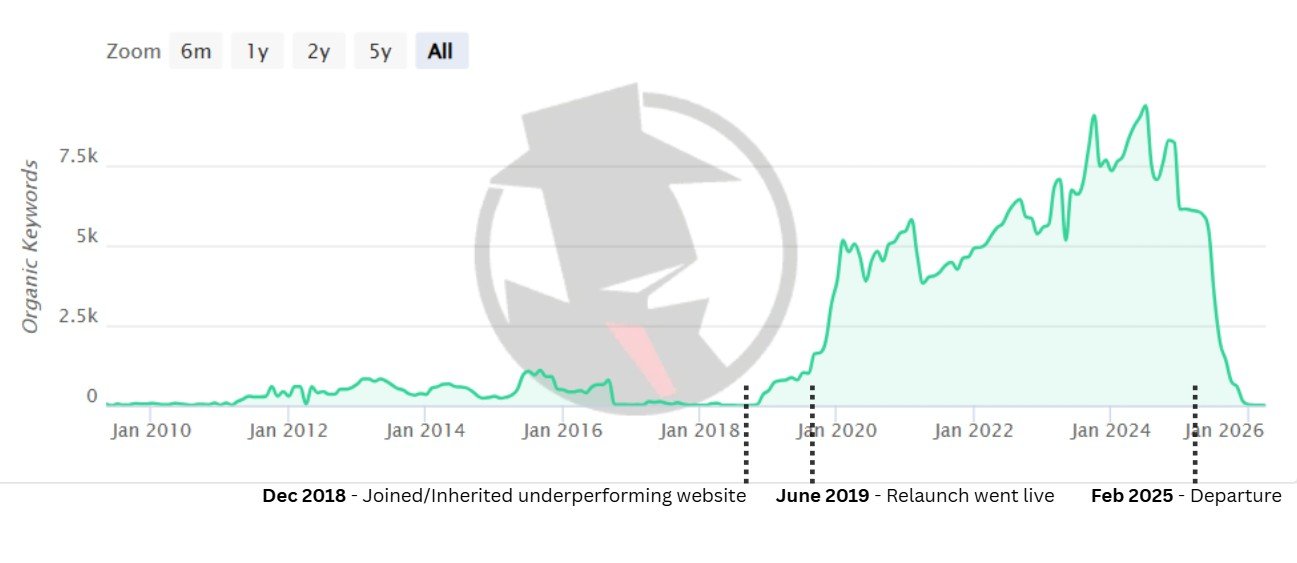
Atlanta Rubber & Hydraulics Inherited a BigCommerce site with broken extensions, payment processing issues, and underperforming revenue. Rebuilt the site architecture, rebuilt the product catalog with proper SEO structure, and managed Google Ads alongside organic. The site grew to 8,000+ keywords and contributed to nearly $500K in online sales in my final year. The company was acquired in 2023.
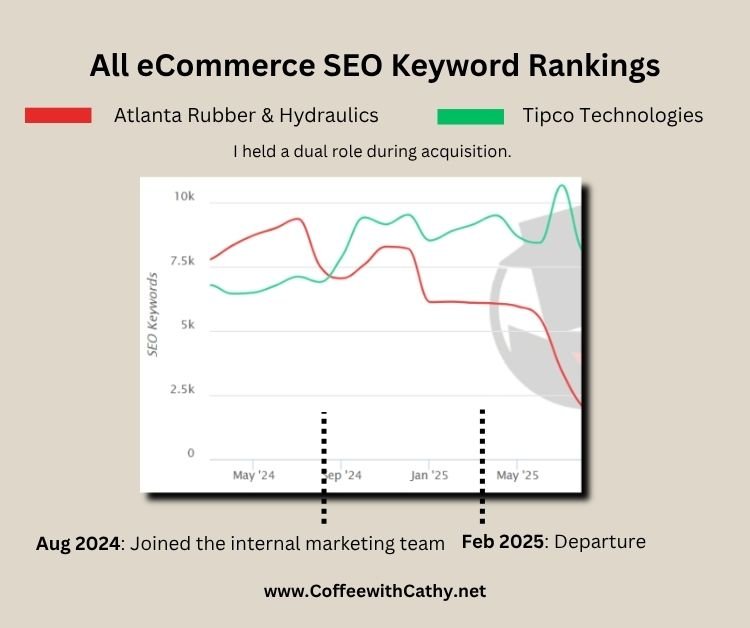
Tipco Technologies Keyword rankings grew from 7,500 to 10,000 during my time there.
How Does Local SEO Work For A B2B eCommerce Site?
Local SEO for a B2B eCommerce site works by tying your online store to the places you actually serve customers: your branches, your warehouse, your service area. Most local SEO advice is written for restaurants and plumbers. Most B2B SEO advice is written for SaaS...
How Do Distributors Get Found Online By Buyers?
Distributors face a specific challenge: buyers are often searching for a product or brand they already know, not searching for "a distributor." Getting found means showing up at the exact moment a buyer is trying to source that product. Rank For The Products You...
Does SEO Work For Niche Industrial Products?
Yes, and often better than people expect. Niche industrial products actually have an advantage in SEO that broader consumer products don't: far less competition for the exact terms buyers are searching. Lower Search Volume Doesn't Mean Lower Value A niche industrial...
What’s The ROI Difference Between SEO And Paid Ads For eCommerce?
This question comes up constantly, and the honest answer is that SEO and paid ads aren't really competing for the same job. They pay off on different timelines, and comparing them head to head misses how they actually work together. Paid Ads: Fast, But Temporary PPC...
How Do I Improve Conversion Rate On My Industrial Online Store?
Conversion rate problems on industrial sites usually come down to friction: too many steps, missing information, or a site that doesn't answer the questions a buyer actually has. Fixing conversion rate is less about tricks and more about removing obstacles. Product...
What Should Show Up When Someone Googles Your Business Name?
Try this right now: open an incognito window and Google your own company name. What do you see? If it's your website, your social profiles, a review site or two, and maybe a local directory listing then you're in solid shape. If a competitor shows up anywhere on that...
AIO and GEO. It’s Still Just SEO.
Everyone's Talking About AIO and GEO. It's Still Just SEO. There's always something new in marketing. A new platform, a new acronym, a new reason to panic and wonder if everything you've been doing is suddenly wrong. Right now, that thing is AIO and GEO. AIO: AI...
Unlocking Revenue Potential: The Business Impact of SEO in Ecommerce
Most eCommerce businesses have products people are actively searching for. The problem is showing up when it counts. That's the short version of what SEO does. It's not a buzzword or a checkbox: it's how customers find you before they ever land on your site. And for...