
How Your Marketing Channels Work Together For Your Business
Think of marketing as a set of roads that all lead to the same place: your website. I’ve created this page and written it in a way that’s easy to understand.
Some roads bring in new people who’ve never heard of you from a Google search, a paid ad, or a post shared on social media. Other roads bring back people who’ve already visited from an email, a reminder ad. But every road leads to your website, and your website is where the sale actually happens.
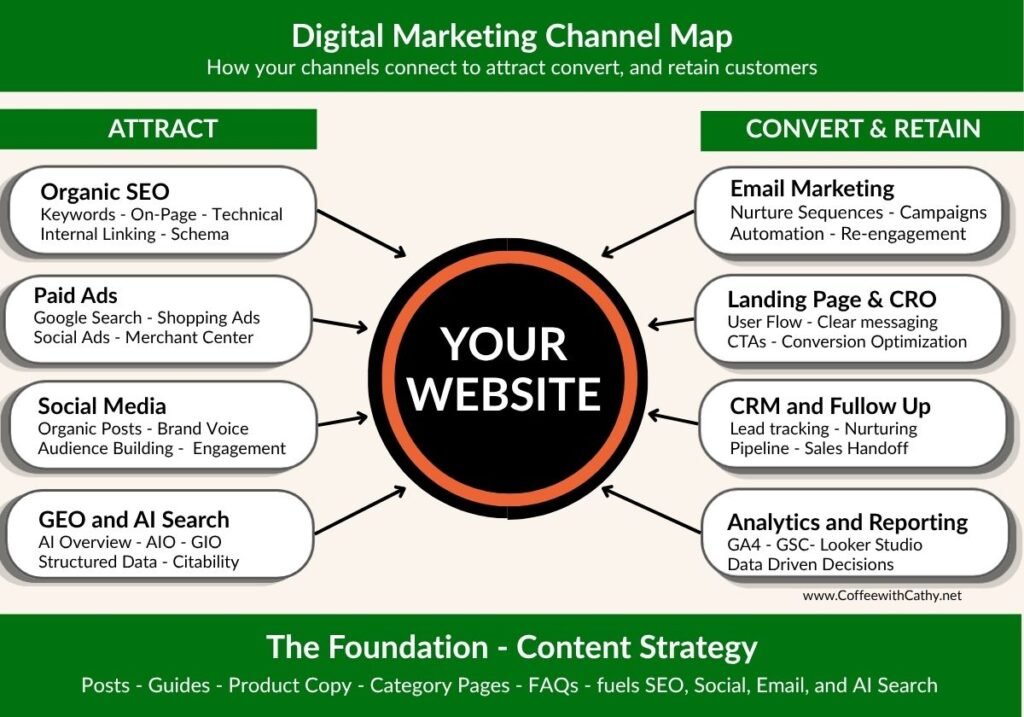
Here’s a simple way to see how it all fits together:
The left side gets customers to your website with search, paid ads, and social media.
The right side keeps customers coming to your website with email, your ordering process, follow-up.
Your website is in the middle because it keeps customers connected to your business.
If the hub, your website, isn’t working, how customers get to it doesn’t matter.
Search Results: Customers Coming To Your Website From Google
When someone searches Google and clicks your result, that’s organic search. You didn’t pay for that click. They were already looking for what you sell.
The customer came from Google with intent to make a purchase on your website. Can your website make the sale?
I wrote about exactly this using two real businesses as examples. Both showed up in search results. One closed the sale. The other lost it before the customer ever got to checkout. Find out what made the difference.
Paid Ads: Customers Coming To Your Website Through Google Ads
With paid ads, you pay for every click. Your ad shows at the top of Google results or inside a customer’s social media feed. The moment they click, they land on your website — and that click cost you money.
Paid ads can be turned off the second you stop paying. But while they’re running, they put your business in front of people who are actively searching for what you sell.
The click costs money. Your website has to make it worth it.
Social Media: Customers Coming To Your Website Through Facebook, Instagram, and LinkedIn
Social media builds awareness. Someone sees your post, your product, or something a friend shared. They may not be ready to buy today, but now they know you exist.
That awareness turns into a website visit when they’re ready — days, weeks, or months later.
The question is whether your website is ready when they finally show up.
AI Visibility: Customers Coming To Your Website Through ChatGPT, Perplexity, and Google AI Overviews
AI search changed how customers find businesses. Instead of a list of links, they get an answer — and sometimes your business is part of that answer. They click through to your website to learn more or buy.
These customers often have strong intent. They were asking a specific question and your business came up.
Whether they stay and buy is still up to your website.