Two companies sell the same products, to the same customers, in the same geography.
One gets roughly 2,700 organic visitors at its peak. The other gets 58,800 consistently.
I pulled their website data side by side. The gap isn’t random.
Branded vs. Non-branded Traffic
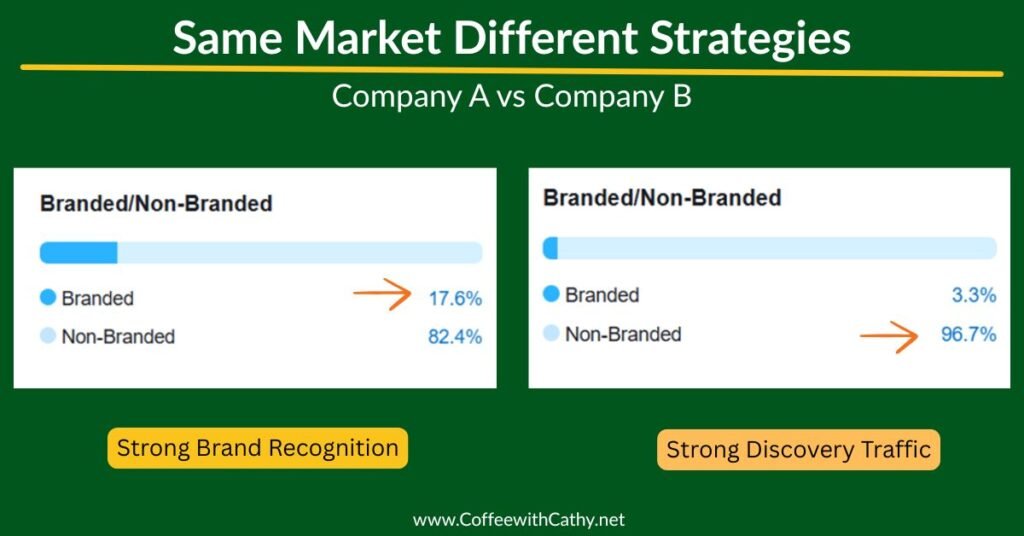
Branded search means someone typing in the company’s name, non-branded is everything else.
Company A gets 17.6% of its traffic from branded searches while Company B gets 3.3%.
What this means for Company A: Most of the people finding them online already know they exist. That’s not bad, it’s great, but it means the website is functioning more like a business card than a sales channel. It’s not bringing in new customers. It’s serving the ones they already have.
What this means for Company B: Almost everyone finding them had no idea who they were before they searched. They looked for a product or a solution and Company B showed up. That’s how online revenue grows, strangers becoming customers.
Comparing the two companies: Company A has a stronger brand recognition, while Company B is lacking in this area. Neither are bad by the way, only areas to improve. If Company A’s business plan is to grow, they would need to concentrate their marketing efforts to gaining new customers through their website. Company B wants to grow, then they will need to work on brand recognition for repeat business.
Real Estate Space On Google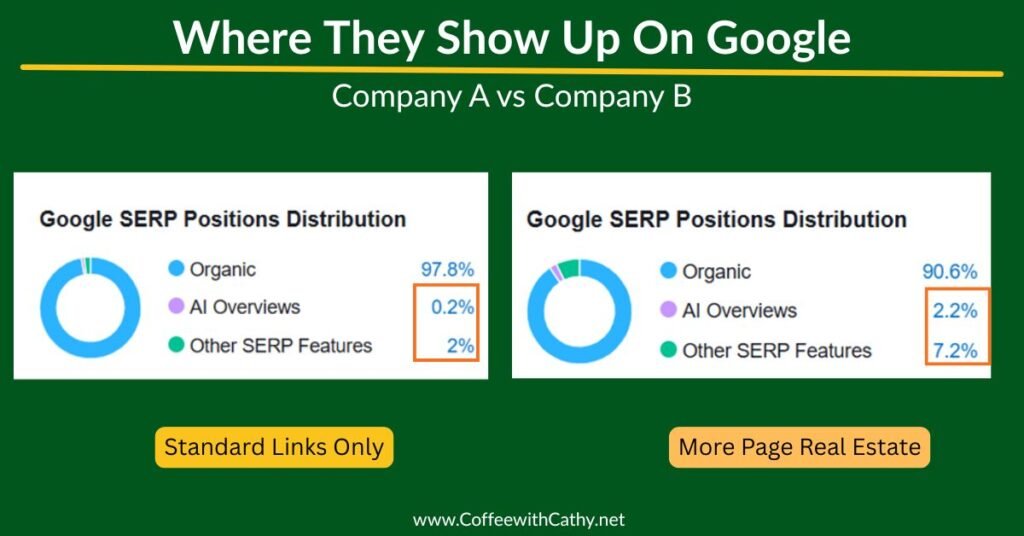
Beyond the standard list of links, Google serves AI Overviews, featured snippets, and other answer features that appear before anyone scrolls. Showing up in those placements means more visibility on the same page.
Company A appears in AI Overviews 0.2% of the time. Company B appears there 2.2% of the time, eleven times more often. Company B also captures 7.2% of Other SERP Features compared to Company A’s 2%.
What this means for Company A: They’re showing up in the standard link list and not much else. Every search results page has more real estate than that: featured boxes, AI-generated answers, quick-answer panels. Not being in them means competitors who are take up more of the page before a buyer ever sees Company A’s name.
What this means for Company B: They’re getting found in more places on the same page. Not just a link in a list: also in the AI answer, the featured box, the quick panel. More placements per search means more chances to get the click.
Comparing the two companies: Company B has a clear advantage here, but this is also the area that changes fastest. AI Overviews and SERP features are relatively new. Company A isn’t locked out, they’re just not there yet. Getting into these placements requires the kind of content that answers specific questions, which is a solvable problem.
Keyword and Customer Intent Breakdown
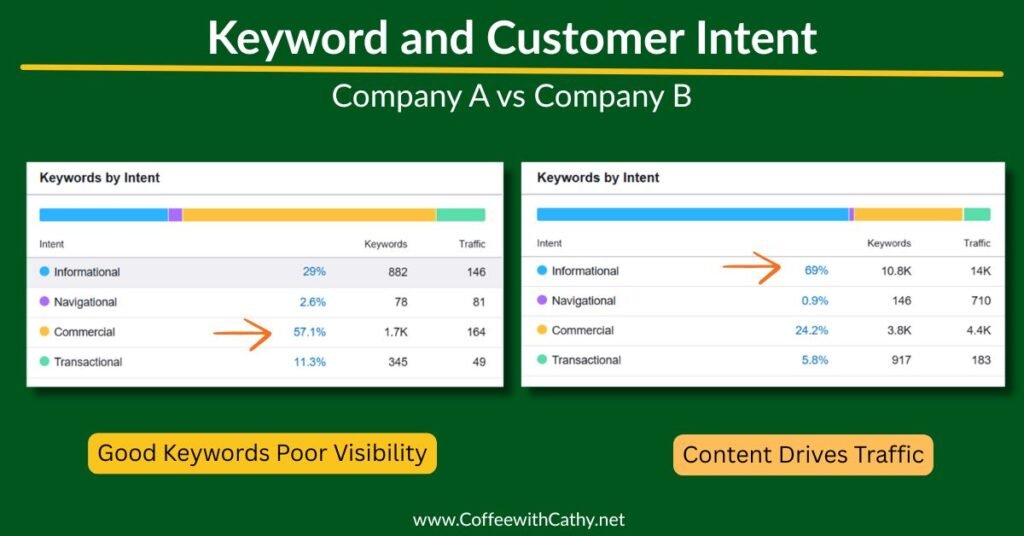
Keyword and customer intent describes what a searcher is trying to do. Informational means they’re researching, they have a question and want an answer. Navigational means they’re using Google to find a specific company or page they already know about, essentially using the search bar as a shortcut instead of typing a web address. Commercial means they’re comparing options and getting close to a decision. Transactional means they’re ready to buy right now.
Company A has 57.1% of its keywords in the Commercial category (1,700 keywords) but only generates 164 visits from them. Navigational sits at 2.6% with 78 keywords and 81 visits. Company B’s largest bucket is Informational at 69% of keywords, driving 14,000 visits. Company B’s Navigational is 0.9% with 146 keywords and 710 visits. Company B earns 4,400 visits from commercial keywords compared to Company A’s 164.
What this means for Company A: They’re targeting the right searches, people close to a buying decision. The problem is they’re showing up on page 5. The keywords are right. The authority to rank for them isn’t built yet, so the traffic isn’t coming. The navigational traffic is small but functional, people who already know them can find them. That’s the floor, not the ceiling.
What this means for Company B: The informational content came first: articles, guides, answers to questions buyers ask before they’re ready to buy. That content built credibility with Google over time. The commercial traffic followed. Company B’s navigational traffic drives 710 visits from only 146 keywords. The people who are looking for them specifically are finding them without friction.
Comparing the two companies: Company A went straight for the buying-intent terms without building the foundation. Company B built the foundation and the commercial rankings came with it. On navigational, both companies are relatively small in this category as it grows naturally as brand recognition builds. It’s a byproduct of doing the other things right, not something you chase directly.
Where Their Rankings Actually Sit
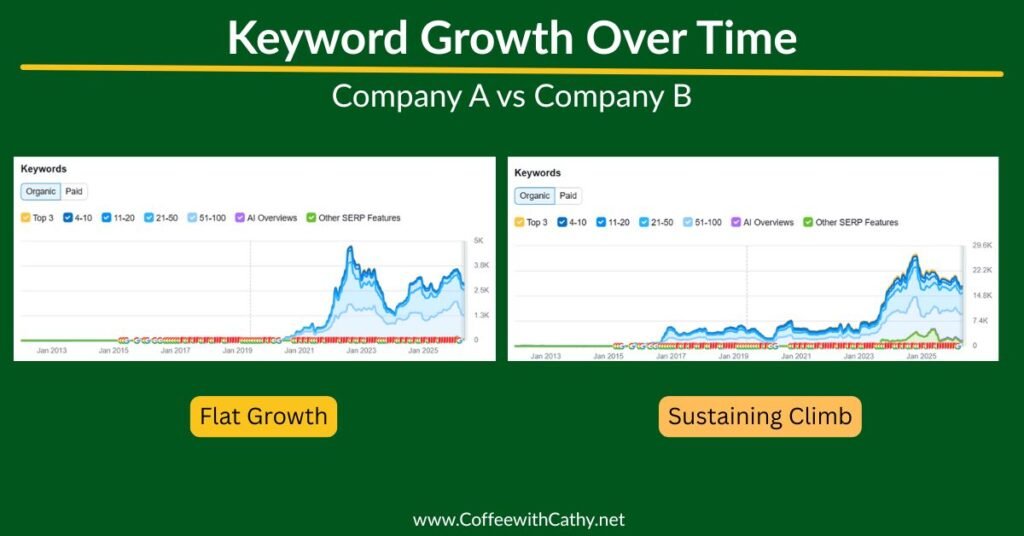
Organic position refers to where a page appears in Google’s search results. Position 1-3 means top of page one. Position 51-100 means page 5 through page 10. Who really scrolls that far for what they are looking for?
Company A’s rankings are concentrated in positions 51-100. Only 52 keywords sit in positions 4-10. Company B has volume across all position ranges with meaningful presence in positions 1-3, 4-10, and 11-20.
What this means for Company A: The majority of what they rank for is buried. Less than 1% of searchers go past page one. If most of a company’s keywords live in positions 51-100, they’re essentially not ranking from a traffic standpoint — the content exists, Google has indexed it, but it’s not being seen.
What this means for Company B: They’re in the game. Page one and page two are where clicks happen. There are still plenty of keywords in lower positions, which means there’s room to grow. The foundation is there and traffic is coming in at the positions that matter.
Comparing the two companies: This is the most direct reflection of the content strategy difference. Rankings don’t move overnight and they don’t move without a reason. Company B earned those positions over time. Company A’s path forward is building the content that justifies better positions. Google will follow.
AI Search: The Next Layer
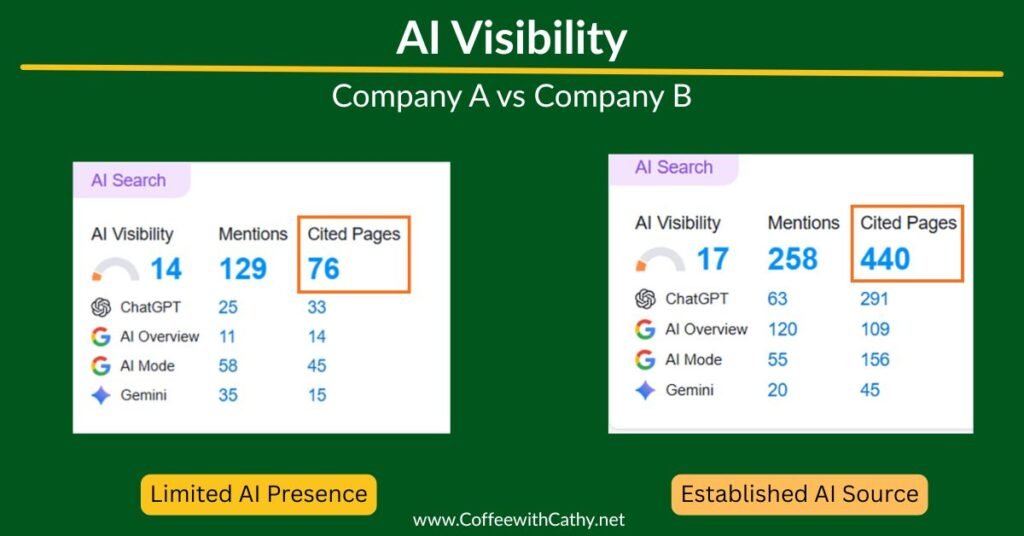
AI visibility measures how often AI tools, ChatGPT, Google AI Overview, AI Mode, and Gemini, mention a company and cite its pages when answering questions. Cited pages is the number the AI is actually pulling from as a source. Since both of these companies are eCommerce, this is important because you want your products to show here.
Company A: 129 total mentions, 76 cited pages. Company B: 258 total mentions, 440 cited pages.
What this means for Company A: When someone asks an AI tool about the products they sell, their content isn’t what gets pulled. 76 cited pages means the AI has a narrow view of who they are and what they know. As more buyers start using AI to research purchases before they ever visit a website, being absent from those answers is the same as being absent from Google page one was five years ago.
What this means for Company B: They’re being used as a source. 440 cited pages means AI tools are pulling from their content when they answer questions in a product category. That’s not luck. It’s a direct result of having published content that answers real questions.
Comparing the two companies: The mention count is 2x. The cited pages gap is nearly 6x. That gap traces back to the same root cause as everything else in this comparison: content volume and content type. Company B answered more questions. AI tools have more to cite. Company A can close this, but it starts with the same step: creating content that answers what buyers are actually asking.
What This Actually Means
Company A has a keyword strategy. They know what terms matter in their category. They haven’t built the authority for Google to rank them where those terms pay off.
Company B made one decision early that changed everything. They answered questions before asking for the sale and that content became their rankings. Those rankings became their traffic. That traffic is now their AI citations.
This is a sequence problem, not a volume problem. You can’t skip the foundation and rank for competitive terms. Google doesn’t work that way. Neither does AI.
The traffic gap between these two companies isn’t about budget or luck. It’s about order of operations. That gap is going to widen, not close, without a content investment.
If you see your business as Company A, Company B, or somewhere in between and want to grow, let’s talk. ☕
Contact Me or View My Portfolio